When you concentrate capital in one business model, the feedback loops are faster and the lessons are sharper. If you are wrong, you know it quickly. And if you are right, the data piles up to form a clear, undeniable picture. That picture has come into focus for us at Viewpoint in 2025, providing the conviction we need to call our shots.
Venture Markets Appear Healthy
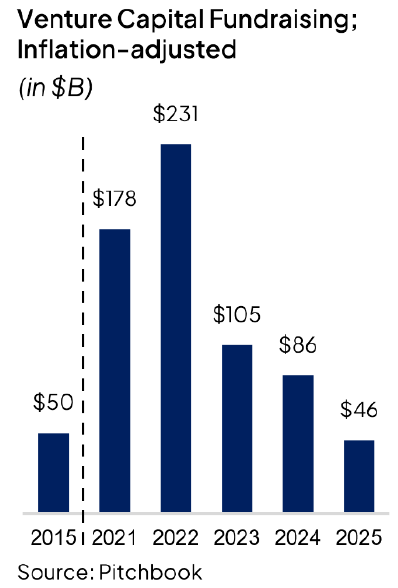
We finally had a year when the venture capital market looked like it was behaving normally again. Capital raised by startups leveled out in 2025 after the dramatic drop-off seen from 2021 to 2023. In terms of fundraising, startups are having fewer down rounds, suggesting valuations are coming into line with reality. There were pockets of increased liquidity: Total IPOs were up for the fourth year in a row and are back to a healthy pace. And among startups on Carta, M&A transactions were up 40% from 2024.
Still, LPs haven’t gotten enough capital back to justify continued investment. That’s putting a damper on VC funds looking to raise capital. On an inflation-adjusted basis, less money flowed into venture in the United States in 2025 than in 2015. What makes this story even more challenging is that half of all capital raised in 2025 went to just five VC firms. For everyone else, even with strong performance, attracting LPs in this environment requires real tenacity. ██ ███ █████ ██ ████ ████████████ █████████ █████ ██████████ ████████ ██████████ ██ ████ ██ ████ █████ ██████ █████████ ██ ████████ ███ ██████
LPs and GPs both are pinning a lot of their 2026 hopes on some exceptional companies deciding to go public, including core players in AI: OpenAI and Anthropic. Others include Databricks, SpaceX, Stripe, Mindbody (Playlist is the parent company), Canva, and Kraken. There is $130 billion invested in these eight companies, about 70% of it just in OpenAI and Anthropic. If some portion of them have IPOs in 2026, it would be a boon to the entire VC industry.
Unsurprisingly, this has revived the question of what share of venture is “AI”—a framing I find increasingly unhelpful. To my mind, AI is no longer a subset of tech or a category into which you bucket deals. It is now the organizing principle of the venture market. It is reshaping how venture allocates capital, values companies, and builds products.
The clearest evidence? The emergence of the newest business model meme in venture:Service-as-Software.
Venture has for decades operated on a rigid binary: Software was “investable” because code scales exponentially. Services were not because human labor scales linearly. But that distinction is being dissolved by generative AI. By deploying AI agents to execute complex workflows—drafting legal documents, resolving customer support tickets, or filing tax returns—startups can now deliver the finished outcomes associated with a service agency while retaining gross margins and scalability akin to a software company.
AI is the reason. Historically, the kind of producer-led markets we invest in lacked integrated tech infrastructure because it wasn’t economically viable to build. But AI simultaneously collapses the cost of software production and cognitive labor. This tectonic shift makes it possible to build platforms that unlock the new, winner-take-most business model that Viewpoint focuses on.
The convergence of this technical revolution and business model innovation creates the perfect environment for startups to displace incumbents.
Viewpoint’s Hunt for Objective Benchmarks
If you’ve read our other quarterly letters, you know Viewpoint’s thesis: human “producers” control demand in large markets that remain under-penetrated by technology, and the best startups don’t try to replace producers—they empower them.
A quick refresher on what we mean by “producer,” because it matters. A producer is a rainmaker: someone whose ability to attract, win and keep clients creates a book of business that follows them, even if they change firms or technology platforms.
Producers show up when trust and accountability are central to the purchase, when buyers want guidance on consequential decisions, or when a skilled advisor is uniquely effective at helping a buyer commit. Their compensation is also at stake; they only get paid when they perform. We estimate roughly $6 trillion—about 20% of US GDP—sits in markets where producers like these control demand.
Producer markets also tend to adhere to the Pareto Principle: the top 10–30% of producers generate 50–90% of the business. If top producers coalesce around a digital platform, a seemingly fragmented market can be consolidated quite quickly.
Inside producer-led industries, Viewpoint has invested in several different business models. Some are marketplaces that connect producers to suppliers (HealthSherpa, Thinksurance). Some are infrastructure layers that shape demand (Nayya, PolicyFly). But our conviction—and our capital—has gravitated toward one specific model: what we call a producer platform.
██ ███ ███████ ████ ███████ █████ ████████ █████ █████ █████ ████ ███████ ███ ████ ████ ████████ █████████ ███████ ████████ ██████ ████████ ██████ ███ ██████ Given the similarities among these businesses and their consistently strong performance, it’s worth delving into this model.
A producer platform is a holistic operating system. It is software plus services. It absorbs the messy, non-revenue-producing work that producers dislike, like operations, compliance, client onboarding, marketing, and other bits of administration. The pitch generally goes: “A large share of your week is spent on non-revenue work. Join our platform, and we’ll give you that time back so that you can use it to serve your clients and grow your book.”
These platforms typically charge based on the flow of business through the platform—e.g., a percentage of revenue—instead of a flat SaaS fee. This is the only model that lets the platform participate in the economics concentrated in the best producers. In practice, it’s the services piece of the platform that earns that right, delivering such value end-to-end that producers are willing to share economics.
These platforms also benefit from a flywheel. They keep improving their technology and adding services, but without increasing their take rate. The platform then becomes even more valuable to the producer. That makes it easier (and cheaper) to recruit more producers, locks them onto the platform, and deepens the moat. Over time, platforms also find ways to monetize suppliers. That also expands margins, which can get reinvested into the product, kicking off a flywheel that drives continued growth.
That said, we also want to sanity-check these performance figures.
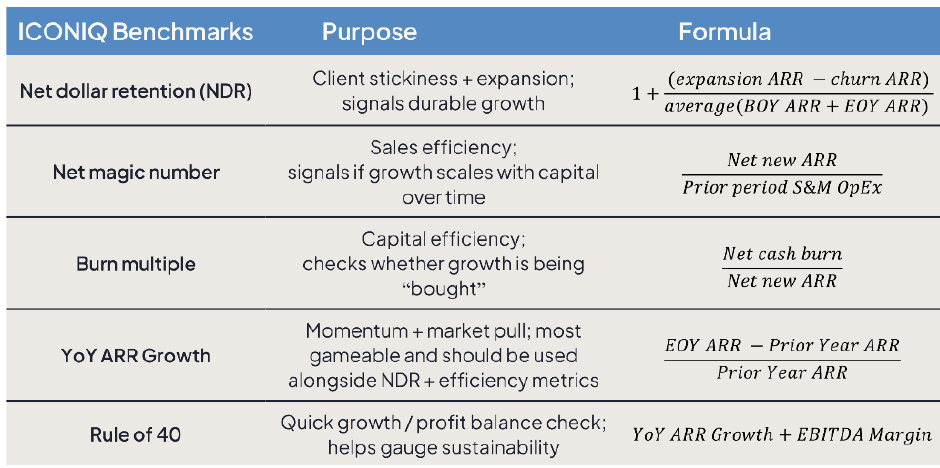
To do that, we looked for some well-established B2B SaaS benchmarks. (Even though producer platforms aren’t pure SaaS, it is possible to normalize their financials to get close to apples-to-apples. Start with gross revenue, subtract what’s owed directly to the producer, and you’re left with a net revenue line whose margin resembles the high gross margin of SaaS revenue.) We opted for the ones used by ICONIQ Capital, █████ █████ ████ ████████████ ████ ██ ███ ███ ████████ ██ ████████ The metrics ICONIQ uses are simple, durable “health checks” for compounding businesses.
███ █████████ ███████ █████ ███████ ██ ███████ A great producer platform attracts increasingly strong producers—often moving up the Pareto curve over time. Those producers then do what they do best: acquire and retain clients through highly differentiated, niche, relationship-driven strategies. The platform then benefits from producers’ distribution, their increased productivity (including the sub-producers they recruit, who catch the “rain” they make), and the durability of their client relationships, all of which are reflected in retention and referrals.
This is where producer platforms differ from SaaS. In many SaaS categories, getting the next customer ██ ██████ ████ █████████ and expensive than the one before. This dynamic is inverted for producer platforms. As the platform’s value to producers compounds, recruiting the next producer gets easier, not harder.
SaaS businesses benefit from scale. Once they’re big enough to cover their fixed costs, an increasing percentage of revenue flows through to EBITDA. This makes it an attractive business model. But with scale, the cost to acquire new customers always goes up. Eventually, further growth gets too costly, and earnings get prioritized over growth. This is why the Rule of 40 is such a powerful metric: It gives growth and earnings equal weight, which is how SaaS businesses should think of those two metrics.
Not so for producer platforms, where growth is more important than EBITDA margin because, with scale, it produces access to a powerful flywheel. The bigger our producer platforms get, the easier it becomes for them to attract more producers, consolidate leverage, extract ever-higher margins from suppliers, and accelerate growth even more. ████ ██ ████ █ █████████ ██ █████████ ████ ███ ███████ ██████████ ███████ █████ ████ █████ ██████ ██ ████ ██ ██ ███████ █████ ██ ████ ███████ ███ ███ ███████
Heading into 2026
At the end of 2025, it felt like we’d reached another level of clarity at Viewpoint. Our thesis matured, and we put metrics to our conviction. We can now articulate and measure what a producer platform is, why it wins, and recognize the stages of progress inside these businesses. ███ ███ ████ ███████████ ███████ ███████ ███ ███████ ████ ██ ███ ████ █████████ ████
We are entering 2026 with more urgency, better data, and █ ████████ █████████ ████ ████. I look forward to seeing and catching up with many of you in the coming weeks and months. As always, thank you for your partnership and support.