
2026 Q1 Letter
Dear Partners, LPs, and Friends,
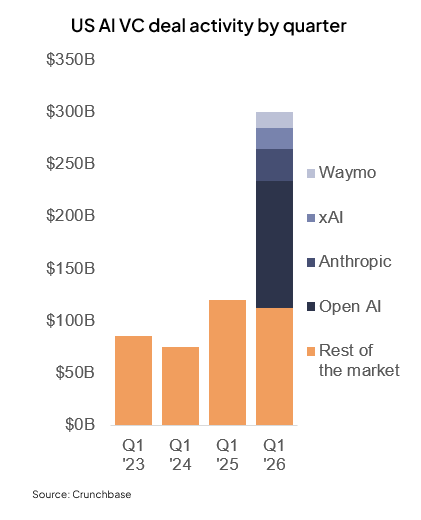
In just Q1 2026, global startup funding hit $300 billion, the largest venture quarter in history. That’s equivalent to 70% of all the funds raised in 2025.
But that headline number does not convey the realities on the ground.
Four companies (OpenAI, Anthropic, xAI, and Waymo) accounted for 65% of the $300 billion, raising more capital than the other 5,996 deals combined. OpenAI alone raised $122 billion at an $852 billion valuation. Strip out the AI mega-rounds and the rest of venture was essentially flat.
There are now two venture markets. They may be operating simultaneously, but they have almost nothing in common.
Market A is the AI mega-deal market. It is enormous, fast-moving, and increasingly disconnected from the rest of the economy. The scale is unprecedented, and so is the concentration of risk.
OpenAI and Anthropic have at least 15 institutional investors in common, including Sequoia and Founders Fund as well as sovereign wealth funds in Singapore, Qatar, and Abu Dhabi. It’s hard to find a top 20 venture or growth equity firm that isn’t in one or both. Most institutional LPs likely have correlated exposure to these companies through multiple fund relationships.
I don’t believe that two companies have ever carried so much weight across so many portfolios. An entire generation of funds is now tied to the outcomes of these types of AI bets. The VC industry needs these companies to perform, or at least not collapse.
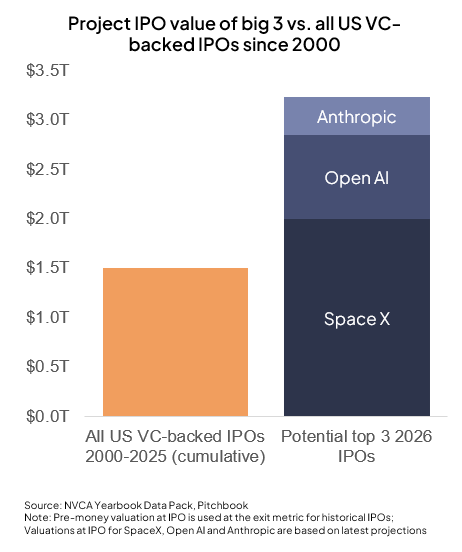
But if they succeed—and particularly if they go public this year—the effect could be transformative for the entire venture ecosystem. IPOs from just SpaceX, OpenAI, and Anthropic would generate more exit value than all US VC-backed IPOs since 2000 combined. SpaceX filed confidentially for its IPO on April 1 at a reported $2 trillion valuation. Founders Fund, which first invested $20 million in 2008, is sitting on an unrealized gain of $19.5 billion.
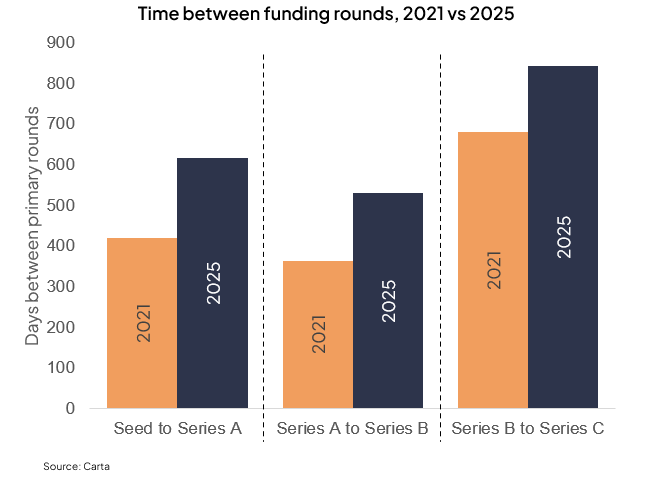
Market B is everything else and it looks very different. The number of seed deals is down 30% year over year. Fundraising cycles have stretched to 23 months at the median. The cash runway at 61% of startups has shrunk from the prior year. AI is sucking all the air out of the room, and companies that would have been comfortably fundable five years ago now struggle to attract attention.
███ ████ █████ ██ ███ ████ █ ██████████ ████████████ ███ ██ ███ ████████ ████████ ████ ████ ██████ ██████ ████ ███████ ██ ███ ██████ ███████ ███████ █████████ ███ ███ ███ ██ ██████ ███ █████ ██████ ██████ ██ ████████ █████████ These are not AI foundation model companies. They are producer platforms in wealth management, real estate, and private aviation—industries where human intermediaries control demand. ████ ███ ███████ ██ █ ██████ ████ ████ ██ ██████ █ ███████
The reason is structural, and that’s what I want to talk about in the rest of this letter.
The Next Class of Aggregators
Three years ago, no VCs had even heard of a "producer," the agents, brokers, and advisors who control demand in hundreds of markets. Today, these markets are at the center of some of the biggest bets in venture. Sequoia, a16z, and Bessemer have all published versions of the "Service-as-Software" thesis, arguing that AI allows startups to provide services to these markets while achieving software-level margins. General Catalyst, Thrive Capital, and Khosla are taking a different approach, deploying billions to roll up mature services firms and retrofit them with AI automation.
I think these VCs are correct that many, many markets are about to be transformed. But they are primarily focused on what AI does to cost structures: how it makes software easier to build, services cheaper to deliver, operations leaner to run. But they are missing the more exciting story. AI is about to bring back one of the most powerful business models that exists: the aggregator.
Aggregation Theory was laid out by Ben Thompson on his blog Stratechery in 2015 to explain the sustained domination of Amazon, Google, Netflix, Uber, Airbnb, and Spotify. The shortest explanation is that, because the internet drops the cost of distribution (discovery plus delivery) to zero, a single platform can provide instant discovery and purchase for all consumers, eliminating the value of a fragmented supply chain. That shifts all the market power from suppliers to whomever owns the customer relationship.
Take Spotify as an example. Before the internet, the music distribution supply chain was fragmented across multiple players at each step, from record labels, pressing plants, and radio stations to distributors and retail stores. This fragmentation was unavoidable. No single record store could carry every song. No single radio station could appeal to every taste. So the market had room for many of each, catering to different niches and geographies. And because a record store only served customers willing to drive to it, you needed thousands of stores to cover the market.
By collapsing the cost to discover and deliver music to effectively zero, Spotify could offer every song ever recorded, instantly available, personalized to your taste, for $10 a month. That was a "10x" improvement over every alternative, and it let Spotify aggregate hundreds of millions of listeners quickly and cheaply.
As listeners poured onto the platform, three forces kicked in simultaneously. Spotify’s recommendation engine got better with every user. Record labels lost their negotiating leverage; with 600 million listeners in one place, they needed Spotify far more than Spotify needed any individual label. And the underlying economics kept improving: the marginal cost of streaming one more song to one more user is essentially zero, which meant the platform’s margins improved with every new subscriber in a way that no smaller competitor could match. These three forces—network effects, leverage over supply, and scale economics—compounded so that Spotify grew faster than anyone else could close the gap.
Every aggregator in history followed this pattern. And they all required new technology to unlock this potential. For Amazon, Google, and Netflix, that unlock was the world wide web: public access to the internet made it possible for a single platform to serve anyone anywhere. For Uber and Spotify, it was the next wave: smartphones. The technological advances didn’t create the aggregator, but rather removed the friction that had kept the market fragmented. Once that friction was gone, the aggregator model was so powerful, and so profitable, that it emerged almost inevitably. Which specific company won each market (Spotify over Pandora, Uber over Lyft) came down to execution, timing, and strategy. But the fact that an aggregator would arise became a near certainty the moment the technical conditions were met.
The Same Dynamic, New Markets
So far, aggregation has only happened in markets where the internet could connect consumers directly to suppliers: music, retail, rideshare, lodging, search. But there are hundreds of markets, collectively representing trillions of dollars of economic activity, where no aggregator has emerged. Not for lack of trying. Billions of VC dollars went into these markets attempting to create direct-to-consumer aggregators, but most failed because they didn’t target the producer.
Insurance. Real estate. Wealth management. Private aviation. Medical spas. Home services. Travel advising. Specialty medicine. These are the markets where Viewpoint invests, and they all share a defining characteristic: demand is controlled not by end buyers browsing a website, but by human producers (agents, brokers, advisors, and owner-operators) who win clients largely through relationships and referrals.
As we laid out in our earlier 2026 letter, producers have structural advantages that made them impervious to the D2C startups that previously tried to disintermediate them. Roughly 70% of clients come through referrals, and retention is relationship-driven. A single high-performing wealth manager can build a seven-figure practice from one office. But the same qualities that made producers resilient also kept their markets fragmented. No individual producer can scale beyond their personal network. The result is thousands of small operators in every market, using disconnected tools, with no scaled-up platform connecting supply to demand. These are exactly the conditions that preceded aggregation in every market that the internet transformed. The only thing missing was a mechanism to aggregate demand without replacing the humans who control it.
AI is that mechanism. By collapsing the cost of building holistic platforms (software plus services that handle a producer’s entire workflow), AI makes it possible to give producers a tool tailored to their work that is 10x better. Not a point-solution tool. Producer platforms are complete operating systems that let producers spend 90% of their time on revenue-generating work instead of 50%. That value proposition is powerful enough to pull producers onto a platform voluntarily. And once enough producers congregate on a single platform, the aggregation dynamics kick in. Suppliers need access to that demand. The platform gains leverage. The flywheel spins.
Not All Producer Markets Are Created Equal
Not all producer markets have the structural ingredients for a dominant aggregator to emerge. We see these markets splitting into three categories. In our view, understanding which category a market falls into is the most important underwriting question in producer-led investing right now.
Category 1: Aggregator markets. These are the markets where we see a clear path to network effects, leverage over supply, or both. When a platform in one of these markets reaches critical mass, its advantages accumulate quickly and it becomes dominant in the market, just as Spotify, Uber, and Amazon dominated theirs. These are the markets Viewpoint focuses on.
What makes a producer market an aggregator market? The presence of a supply side that needs to access the demand that producers control, and that will pay for it. In insurance, carriers compete to get their products in front of agents. In private aviation, fleet operators compete to fill their planes through brokers. In wealth management, asset managers and custodians compete to attract advisors’ client assets. As more producers use a common platform, suppliers become increasingly dependent on it for distribution. The platform gains pricing power. That revenue funds further growth. Network effects compound the advantage: as it adds participants, the platform gets meaningfully better for everyone, which accelerates adoption on both the supply and demand sides. The flywheel produces the same winner-take-most outcome that aggregation always produces.
Category 2: Roll-up markets. Some producer-led markets have neither meaningful network effects nor leverage over a monetizable supply side. Think of an accounting practice. The producer’s value is real (clients trust their accountant) but there are no network effects and no suppliers to gain leverage over. Without those, there is no accumulating advantage to scale, and no flywheel.
This is the model that General Catalyst, Thrive, and Khosla are pursuing, and we think it will work well in markets where the services are relatively standardized (tax preparation, bookkeeping, IT support) and don’t require physical presence to do the task. So long as they can buy profitable firms at reasonable multiples, apply AI to expand margins, and build a large, efficient operation, this should succeed. Indeed, it’s just the AI version of the play private equity has been running for years.
But the result is a fundamentally different business than an aggregator. Roll-ups are about gaining margin through efficiency and cost reduction. Aggregators are about providing an amazing product for the best producers to drive rapid adoption. These are very different strategies, and they suit very different markets.
Category 3: Commodity software markets. In some producer-led markets, neither aggregation nor roll-ups are the likely outcome. These are markets where the producer’s work has a meaningful physical component (think nail salons, hair salons, personal training). There is no supply side to gain leverage over, no network effects, no recurring revenue to support debt, and the physical nature of the service limits how much AI can change the economics. AI can help with scheduling or marketing, but it can’t cut hair or double the time in the stylist’s day.
In these markets, it comes down to software. And because AI has collapsed the cost of building software, the software itself will become commoditized. Producers may "vibe-code" their own solutions or choose from a host of low-cost, AI-generated tools the way many already use apps. Margins will be thin. Differentiation will be difficult. This is not where Viewpoint invests, and it’s not where the roll-up firms will find their best opportunities either, because there’s nothing defensible to build or buy.
Of the roughly 200 producer-led markets Viewpoint has mapped, we believe half have the structural ingredients for aggregation. These are winner-take-most markets, and they are where our capital is concentrated.
In my annual letter, I said that Viewpoint’s mission for 2026 is to build durable moats around our own advantage. The most important of those is proprietary knowledge. No other fund has a portfolio of 10+ producer platforms across different verticals, all running the same underlying model.
This quarter, we began systematically capturing the operational and financial data from across our portfolio to build benchmarks that don’t exist anywhere else: what the aggregation curve looks like at different stages, where AI is changing unit economics, what separates the platforms that are winning from those that aren’t. This data sharpens everything we do, from underwriting to board-level advising. I’ll have more to share next quarter.
The second moat is to make Viewpoint the center of gravity for this thesis. We have put together a presentation that takes the ideas in this letter further, examining how the rise of aggregators in producer-led markets will create material threats and opportunities across growth equity, private equity, and private credit. We have a dozen in-person sessions being scheduled with investors across these asset classes. If you, or anyone in your network, would find it valuable to better understand the shifts we see happening, please reach out.
███████ █████████ ████ ██ ██ ███████████ ███ █████ █████ ████ █ █████ ██████ ██ █████████ █████████ ███ ████ ███ ████████ ████ ███ █████████ ████ █████ █████ ██ ███ ████ ███████████ ██ ████ ████ ███ ███████████ ██ ████████████ ███████ ████ ██ ███ ██ ███ ████████ ██████ ██ ███████ ████ ███ ████ ███████ ██████████ ██ ███ █████████ ███ ██████████ ███ █████ ███ ██████████████ ██ ████████ ██ ████████ ██████ ████ ███████████
As always, thank you for your partnership and support.
Fondly,

Drew Aldrich, Managing Partner
www.viewpoint.vc | hello@viewpoint.vc
Building in a producer
market? Let’s talk