
2026 Q2 Letter
Dear Partners and Friends,
The venture market is living in extremes.
Venture just posted its largest-ever half-year. More than $500 billion was invested globally—but 43% of it went just to OpenAI and Anthropic. The last six months of exits also set new records — almost entirely driven by SpaceX’s IPO at a $1.77 trillion valuation, the largest in history. And its $250 billion acquisition of xAI and another $60 billion for Cursor accounted for most M&A value.

In the U.S., capital is concentrating into fewer companies at both ends of the market. The top 1% by valuation now get 33% of VC dollars, up from 12% in 2022. At the seed stage, capital deployed held roughly flat year over year from Q2 ’25 to Q2 ’26 while deal count fell about 30%. The ones that do raise find the next step harder to reach: the median time to Series A now exceeds two years, and roughly half of all seed financings are bridges rather than progression rounds. Seed-to-Series A conversion has collapsed to about 9% (versus 15–20% historically).
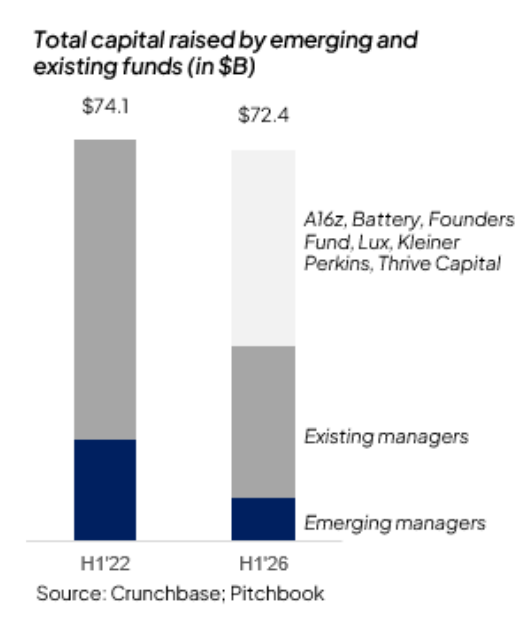
These dynamics are squeezing fund managers, too. In the 2020–21 era, roughly a third of investment capital dollars went to emerging managers. Last year, that share was about 25%. In the first half of this year, it was 11%. Put another way, 89% of all capital went to “established” managers (firms that have raised four or more funds previously). Within that set, just six firms—a16z, Thrive, Founders Fund, Battery, Kleiner Perkins, and Lux—raised $36.4 billion, 50% of the year’s total. Of the 2,220 VCs that launched funds in 2021–22, only 653 have raised a follow-on. █████████ ██ ███ ██ ████. These extremes might seem shocking, but I’d suggest that they are evidence of a healthy VC market. Venture is a power law business. When the data starts flattening—when most seed companies make it to Series A, when anyone can raise a fund—those are the bad vintages in the making.
Fund managers have to prove to their investors that they know something others don’t, or that they have access to alpha others can’t reach. That is incredibly hard. It usually requires being smarter, luckier, and consistently outperforming the competition. But as a founder said to me recently, “There is no crying in the casino.”
The Last Aggregator
Last quarter’s letter (which you can read here) argued that we are about to see the creation of 50 to 100 new aggregators in Producer Markets. Aggregators are the companies that consolidate demand onto one platform—such as Amazon, Google, Uber or Spotify—and, in doing so, gain the power to set the terms for everyone else in the market. No business model has created more value, and none is harder to build. Arguably, the last large-scale aggregator was the trading platform Robinhood, founded in 2013.
Robinhood’s founders were the first to realize that the latest technology could execute trades at near-zero cost. That let them offer trading for free and attract millions of customers. And that ultra-low marginal cost, combined with rapid customer aggregation, let them flip the traditional business model on its head: free to clients, while charging the supply side—market makers like Citadel Securities—for access to this new, highly valuable flow of retail orders. Selling order flow wasn’t new, of course. But a cost structure lean enough to live on it was.
The incumbents tried to respond. In a single week in October 2019, Schwab, TD Ameritrade, and E*Trade all slashed their commissions to zero. It wasn’t enough. They couldn’t replicate the benefits of a new tech stack, and it is nearly impossible to retrain an entire workforce around a new business model. TD Ameritrade’s stock fell 25% in a day, and within months it was acquired by Schwab, while E*Trade sold to Morgan Stanley. Today, Robinhood has nearly 28 million funded accounts, $345 billion in customer assets, and a market cap north of $100 billion.
The Robinhood story illustrates how the core “triangle” of aggregators gets built. The catalyst is a new technology that enables a product that could not have existed before—in Robinhood’s case, free trading. The first side of the triangle is a product so much better than every alternative that customer acquisition cost collapses. The second side is that the same technology collapses the cost to serve those customers, so the platform can absorb enormous scale without its economics eroding. Those two sides unlock the third: the platform can flip the market’s business model and start making suppliers pay to reach the customers the platform controls.
Aggregators use a technical disruption to force a business model disruption. That combination is uniquely lethal to incumbents. E*Trade could match free trades, but it could not become a company built on supply-side economics. Everything—its infrastructure, its cost structure, its workforce—was built for the old model.
And while incumbents struggle, the aggregator’s growth flywheel starts spinning. For a non-aggregator, growth creates drag: each additional customer costs more to win and more to serve than the last. Aggregators invert this. More customers make the supply side pay more for access. Supply-side profits fund a better product. A better product attracts customers at ever-lower cost.
Meanwhile, scale widens the aggregators’ moats: network effects a smaller competitor cannot replicate, pricing power over suppliers, proprietary data that compounds, and switching costs that quietly lock in demand. The lead widens instead of eroding. That is why the survival window for incumbents is so short. E*Trade and TD Ameritrade lost to Robinhood in less than six years.
We Had a Good Idea. Then We Got Lucky.
When we founded Viewpoint in 2022, we built it around a real insight. In large markets like insurance, wealth management, and real estate, human producers have a unique ability to acquire customers. Their relationships and referrals gave them command of their client base in a way that no amount of ad spend could interrupt. Our thesis was that using the latest technology to aggregate demand in Producer Markets was uniquely valuable precisely because it was so difficult. The same producers who made these markets impervious to D2C startups made the demand, once aggregated, extraordinarily durable and valuable.
We were not the first to spot the value in these markets. Private equity got there years before us, spending at least $200 billion to roll up insurance brokerages and wealth managers since 2015. What we recognized was the flaw in the rollup plan: it buys producers… but they can leave the new company. So, if a neutral platform comes along that will help them become meaningfully more productive, and thus earn more, they can walk out the door with their clients.
Rollups can buy demand. They can never aggregate it. Or, in the language of the triangle: rollups don’t use technology to build a product producers love, so acquisition never gets cheap—every producer must be bought. They don’t use technology to collapse the cost to serve, so growth adds drag rather than margin. Without those two sides, they never become aggregators. A rollup ends up owning a collection of firms rather than dominating a market the way Amazon and Google dominate theirs.
What we could not have guessed in 2022 was that we were founding Viewpoint in the opening months of a platform shift. Platform shifts—mainframe to PC, PC to internet, internet to mobile—are the rare moments when the technological substrate of the economy changes and the winners get reshuffled. They arrive every decade or so, and they can make even the most sophisticated thesis obsolete.
This one broke our way. AI has collapsed the two costs that had confined our thesis—building software and delivering services—and our insight about a handful of markets now can be applied to ten times as many. We got lucky. And the luck landed on a firm already built to use it.
Because our portfolio is concentrated in companies with the same underlying business model, ████ ███ ██ ████████ ███████ ██ ████████ █████████, we’re learning about that model at a speed no generalist can match. That intelligence cannot be acquired from the outside. You have to sit with these companies, board meeting after board meeting, to see where the power accrues and where it doesn’t, to glean which supply sides will pay and which never will. That experience has sharpened our thesis, too: we started out backing any startup that could aggregate demand in a Producer Market; today we focus specifically on platforms that aggregate the producers themselves and thus capture demand. ███ ████████
The Next 100 Aggregators
Viewpoint spent the first half of Q2 building a new presentation we’re calling “The Next 100 Aggregators.” It’s the full argument laid out so that someone encountering the thesis for the first time can follow every step.
I’ve now given that presentation more than 50 times—to founders, VCs, growth and private equity investors, and LPs—and the response is unlike anything we’ve received relative to what we have shared before. Audiences don’t just comprehend our thesis; they now come away seeing the same inevitability that we do.
I love giving this presentation. If you—or your partners, your investment committee, or a group in your network—would like to hear the full version, please reach out. We’ve included a sneak preview of the read-only version below.
As always, thank you for your partnership and support.
Fondly,
Drew Aldrich, Managing Partner
www.viewpoint.vc | hello@viewpoint.vc
Building in a producer
market? Let’s talk